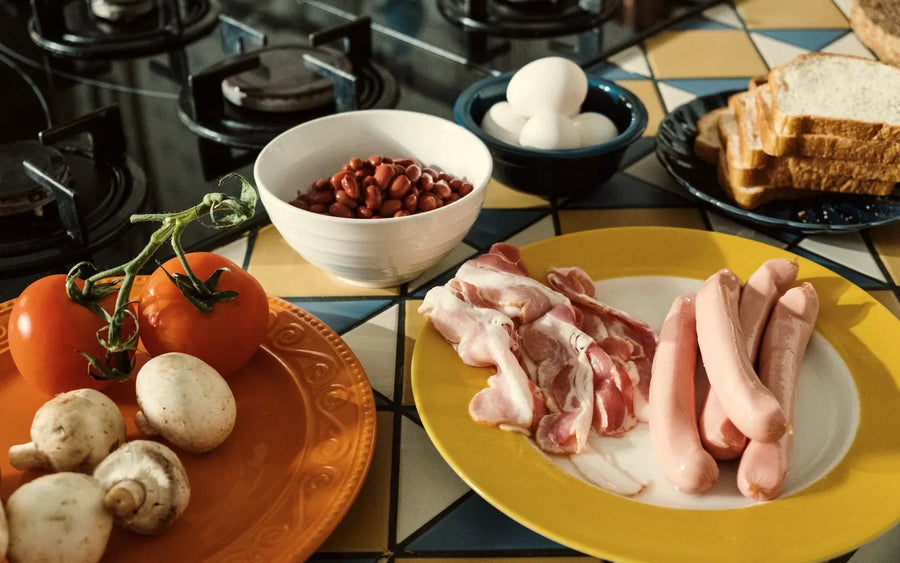
How much protein do you need a day? The math and the plate
A healthy adult needs 0.83 g of protein per kilogram of body weight a day (EFSA), which comes to about 54 g at 65 kg. Ask the internet, though, and you get at least four different answers: 50 g, "a gram per kilo", "two grams per kilo", "the more the better". No wonder a 2025 Blue Point survey for Danone found that only 1 in 4 people aged 18 to 65 know the recommended daily intake. Here you'll find the official number, when it goes up, the math already done for 55, 65 and 80 kg, and what all of it looks like on your plate.
In short
- Healthy adult: 0.83 g of protein per kilogram of body weight a day (EFSA). At 65 kg, that's about 54 g.
- After 65, the PROT-AGE and ESPEN expert groups recommend at least 1.0 to 1.2 g per kilogram.
- If you train regularly, the International Society of Sports Nutrition (ISSN) gives 1.4 to 2.0 g per kilogram.
- An ordinary day with 2 eggs, a bowl of beans, yogurt and pasta with cheese adds up to about 60 g of protein.
- Up to twice the recommended intake is considered safe for healthy adults (EFSA).
The official number: 0.83 g per kilogram
In 2012, the European Food Safety Authority (EFSA) set the reference intake of protein for adults: 0.83 g per kilogram of body weight a day. The number is the same for women and men, for every body weight and for every age from adulthood on, including after 65.
Where does it come from? Protein contains nitrogen. Scientists measure how much nitrogen goes into the body with food and how much comes out. When the two are equal, the body is getting as much protein as it needs. From studies like these, EFSA calculates an average requirement of 0.66 g per kilogram.
An average, however, doesn't cover everyone. So EFSA raises the number until it covers the needs of 97.5% of healthy adults, and lands at 0.83 g. In other words, the recommendation already has a safety margin built in.
Myth
"0.83 g is the bare minimum you need to scrape by." In fact, it's the intake that covers the needs of almost all healthy adults, with a margin built in. The number goes up in specific cases: after 65, with regular training, and during pregnancy and breastfeeding.
How to work out your number
The math is the same for everyone: your weight in kilograms, multiplied by the factor for your situation.
- Take your weight. Say, 65 kg.
- Pick your factor. 0.83 for a healthy adult, 1.0 to 1.2 after 65, 1.4 to 2.0 if you train regularly.
- Multiply. 65 × 0.83 = 54 g of protein a day.
Here's the math already done for three common body weights, rounded to the nearest gram:
| Weight | Healthy adult (0.83 g/kg) | After 65 (1.0 to 1.2 g/kg) | Regular training (1.4 to 2.0 g/kg) |
|---|---|---|---|
| 55 kg | 46 g | 55 to 66 g | 77 to 110 g |
| 65 kg | 54 g | 65 to 78 g | 91 to 130 g |
| 80 kg | 66 g | 80 to 96 g | 112 to 160 g |
You don't add the factors together. If you're 70 and regularly active, go by the recommendation for active people over 65: 1.2 g per kilogram and up.

When you need more
After 65
EFSA doesn't give a separate number for people over 65. In its view, there isn't enough data, and the recommendation is at least the same as for younger adults. Two European expert groups go further. PROT-AGE (2013) and the European clinical nutrition society ESPEN (2014) advise healthy people over 65 to get at least 1.0 to 1.2 g per kilogram a day.
For people over 65 who exercise or are simply active, PROT-AGE gives 1.2 g or more. In Germany, the official recommendation for everyone over 65 is 1.0 g per kilogram (DGE, 2019). Why does any of this matter? Protein contributes to the maintenance of muscle mass, and your muscles are what carry the shopping bags home and take you up the stairs. There's more on this in our article on protein and aging.
One important exception: with severe kidney disease, PROT-AGE notes that intake may need to be limited. If that's your situation, ask your doctor.
If you train regularly
The ISSN recommends 1.4 to 2.0 g per kilogram a day for most people who exercise. That means regular movement several times a week: running, swimming, dancing, cycling, lifting weights. Protein contributes to a growth in muscle mass. The details are in our article on protein and muscle.
During pregnancy and breastfeeding
EFSA adds 1 g a day to the usual recommendation in the first trimester, 9 g in the second and 28 g in the third. While breastfeeding, the extra is 19 g a day for the first 6 months and 13 g after that. For scale: 28 g is about 4 and a half eggs. For your own situation, ask your doctor.
What that looks like in food
Grams of protein sound abstract until you see them on a plate. The numbers below come from USDA FoodData Central, the US public database of food composition. For Bulgarian white cheese we use the data for feta, and for strained yogurt the data for Greek yogurt, because they're the closest match.
| Food | Serving | Protein |
|---|---|---|
| Egg | 1 large (50 g) | 6.3 g |
| White cheese (based on feta) | 50 g | 7.1 g |
| Yogurt, whole milk | 200 g | 6.9 g |
| Strained yogurt (based on Greek) | 150 g | 13.5 g |
| Milk, whole | 1 glass (250 g) | 7.9 g |
| White beans, cooked | 200 g | 19.5 g |
| Lentils, cooked | 200 g | 18.0 g |
| Chicken breast, roasted | 120 g | 37.2 g |
| Pasta, cooked | 200 g | 11.6 g |
| White bread | 1 slice (29 g) | 2.6 g |

An ordinary day at 65 kg
- Breakfast: 2 eggs and a slice of bread, about 15.2 g.
- Lunch: 200 g of beans and a slice of bread, about 22.1 g.
- Afternoon: 200 g of yogurt, about 6.9 g.
- Dinner: 200 g of pasta with 30 g of white cheese, about 15.9 g.
That's about 60 g in total, above the recommended 54 g. No special products needed. Grandma's cooking does pretty well.
And if you're 70 and weigh 65 kg? Your target is 65 to 78 g. Add 150 g of strained yogurt (13.5 g) and one more egg (6.3 g), and you're at about 80 g. Another option is 1 serving (30 g) of MEALUP sprinkled over the pasta: at least 20 g of protein from egg white and milk protein, without changing the recipe.
The good news: EFSA judges protein intake in Europe to be adequate for all population groups. The recommendation goes up mainly after 65 and with regular training, and that's exactly where an ordinary day may fall short.
Can you have too much?
EFSA doesn't set an upper limit for protein, because there isn't enough data to set one. At the same time, it notes that intakes of up to twice the recommendation, that is, up to about 1.7 g per kilogram, are common among physically active, healthy adults in Europe and are considered safe.
With severe kidney disease, the recommendations are lower (ESPEN, 2014). If that applies to you, ask your doctor. What science says about protein and the kidneys of healthy people is covered in our article on protein myths.

When you eat it matters too
The daily number doesn't tell the whole story. For people who train, the ISSN recommends getting protein in servings of about 0.25 g per kilogram, or 20 to 40 g, every 3 to 4 hours. If your breakfast is a pastry and coffee and your dinner is a big plate of moussaka, the day may add up on paper, but the protein is all in one place.
Nothing wrong with the pastry. Add a yogurt or an egg to it and the numbers even out. We show you how to do that without turning your menu upside down in our guide to spreading protein through the day.
Frequently asked questions
Do I count the protein from bread, pasta and beans?
Yes. EFSA states explicitly that the recommendation applies both to high-quality protein and to protein from a mixed diet, meaning everything you eat. For the quality differences between animal and plant proteins, see our article on animal vs. plant protein.
Do men need more protein?
Per kilogram of body weight, the need is the same (EFSA). Men usually weigh more, so in grams it comes out higher.
Where does that "2 g per kilo for everyone" come from?
The upper end of the ISSN recommendation is 2.0 g per kilogram, and it applies to people who train. For a healthy adult, the reference number is 0.83 g per kilogram.
Do I need to count protein every day?
No need. Work out your number once, compare it with one of your ordinary days using the table above, and you'll know if you're close to your target.
I'm pregnant. How much protein do I need?
EFSA adds 1, 9 and 28 g a day to the usual recommendation for the first, second and third trimester. Every pregnancy is different, so ask your doctor.
Work out your number once, then go back to your favorite dishes. In the example above, the gap to the higher target was one strained yogurt and one egg.
Sources
- EFSA, "EFSA sets population reference intakes for protein", press release, 2012
- EFSA NDA Panel, "Scientific Opinion on Dietary Reference Values for protein", draft for public consultation, 2011 (final: EFSA Journal 2012;10(2):2557)
- European Commission, Knowledge for Policy, "Dietary recommendations for protein intake for adults and older adults", 2026
- Bauer J., Biolo G., Cederholm T. et al., "Evidence-based recommendations for optimal dietary protein intake in older people: a position paper from the PROT-AGE Study Group", Journal of the American Medical Directors Association, 2013
- Deutz N. E. P. et al., "Protein intake and exercise for optimal muscle function with aging: Recommendations from the ESPEN Expert Group", Clinical Nutrition, 2014
- Jäger R., Kerksick C. M., Campbell B. I. et al., "International Society of Sports Nutrition Position Stand: protein and exercise", Journal of the International Society of Sports Nutrition, 2017
- USDA, FoodData Central, SR Legacy: egg 171287, feta 173420, yogurt 171284 and 171304, milk 171265, white beans 175203, lentils 172421, chicken breast 171477, pasta 169737, white bread 174924
- Blue Point for Danone, national survey, July 2025 (via Cross.bg, 09.10.2025)