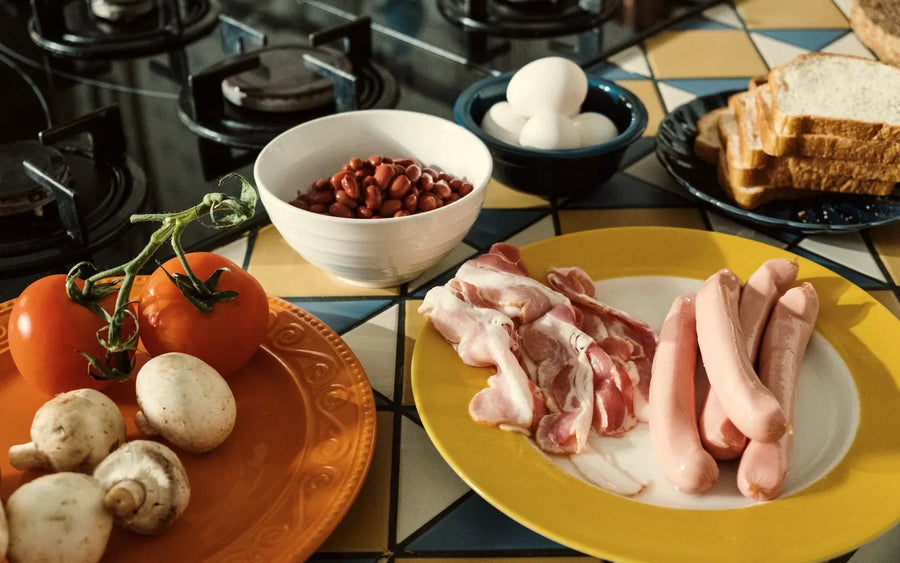
How to spread protein across breakfast, lunch and dinner
First get the protein you need for the day, then split it more evenly between breakfast, lunch and dinner: 0.25 to 0.4 g per kilogram of body weight per meal, or about 16 to 26 g for someone who weighs 65 kg. An ordinary day, though, often looks like this: coffee and a kifla (a Bulgarian crescent roll) on the go in the morning, a sandwich at the computer for lunch, a big plate of moussaka in the evening. The protein for the day may add up, but almost all of it is in dinner. Here you'll find what research says about spreading protein through the day, how much to have in one meal, and how to upgrade breakfast without giving up your banitsa (Bulgarian cheese pastry).
In short
- The daily total comes first. Spreading it out is the second step: useful, but smaller.
- In a 2014 study, the even day (about 30 g at each of three meals) produced 25% more muscle protein building over 24 hours than the day with almost everything at dinner.
- A guide for one meal: 0.25 to 0.4 g of protein per kilogram of body weight. At 65 kg, that's about 16 to 26 g.
- The weak spot is usually breakfast: one kifla gives about 4.7 g. An egg, some white cheese or strained yogurt next to it fixes the math.
- The long-term effect on muscle is still being studied, so there's no need to count every gram.
What protein looks like on an ordinary day
For most people, protein piles up toward the evening. The authors of the study we'll get to in a moment describe it this way: intake is often skewed toward dinner, while breakfast is usually high in carbohydrates and low in protein.
A well-measured example comes from the Netherlands. Researchers collected the food diaries of 1 279 older adults: people living at home, frail older people and care home residents. Their breakfast provided 10 to 12 g of protein, lunch 15 to 23 g and dinner 24 to 31 g. In the morning, more than half of the protein came from plant foods, mostly bread.
Nothing wrong with dinner. The question is this: does it matter to your body whether you eat your protein all at once or over several meals?
What the even-day study showed
First, one piece of science, explained simply. Your muscles are constantly renewing themselves. The body breaks down some muscle protein and builds new protein. Scientists call the building part muscle protein synthesis, and they measure it in the lab.
In 2014, a team with Mamerow as first author compared two ways of eating. Eight healthy men and women, average age about 37, ate each way for 7 days. In both cases the food had the same calories and almost the same protein, about 90 g a day. The only difference was how it was spread out.
| Meal | Even day | Dinner-heavy day |
|---|---|---|
| Breakfast | 31.5 g | 10.7 g |
| Lunch | 29.9 g | 16.0 g |
| Dinner | 32.7 g | 63.4 g |
The result: on the even day, muscle protein synthesis over 24 hours was 25% higher. The difference held after a week on the same pattern.
People who train show a similar picture. In a 2013 study, 24 men were given 80 g of milk protein over 12 hours after a weight-training session. Taking 20 g every 3 hours produced stronger synthesis than 10 g every hour and a half or 40 g every 6 hours.
It's also worth knowing the limits. Eight people over one week make a small study. It measures a process in the muscle over 24 hours. Muscle mass years later is outside its scope.
How much protein per meal
The International Society of Sports Nutrition (ISSN) recommends that people who train have about 0.25 g of high-quality protein per kilogram of body weight per meal, or 20 to 40 g, every 3 to 4 hours.
Schoenfeld and Aragon go a little higher. In a 2018 review, they suggest 0.4 g per kilogram per meal, across at least four meals, for people who want to build as much muscle as possible. And if you divide EFSA's recommendation for a healthy adult (0.83 g per kilogram a day) across three meals, you get about 0.28 g per meal, close to the lower end.
After 65, muscles respond less to small amounts. In a 2015 analysis by Moore and colleagues, older men needed about 0.40 g per kilogram in one meal, and younger men about 0.24 g. There's more on this in our article on protein and aging.
| Weight | 0.25 g/kg per meal | 0.4 g/kg per meal |
|---|---|---|
| 55 kg | 14 g | 22 g |
| 65 kg | 16 g | 26 g |
| 80 kg | 20 g | 32 g |
Myth
"Your body only absorbs 30 g of protein per meal, and the rest goes to waste." Schoenfeld and Aragon write that the amount that can be absorbed is practically unlimited. With bigger servings, more amino acids are broken down, but some of them are still used for building. More in our article on protein myths.
The Bulgarian breakfast: where the gap is
A small banitsa and ayran (a salty yogurt drink), a kifla and coffee, a slice of bread with lyutenitsa (a roasted red pepper and tomato relish). It's tasty, it's quick, and for many people this is exactly how the morning starts. The pastry is fine. These breakfasts are simply low in protein.
Here are the numbers from USDA FoodData Central, the US public database of food composition. A medium kifla made with butter dough (57 g, based on the data for a croissant) has about 4.7 g of protein. A 120 g piece of banitsa has about 9.9 g, going by the data for spanakopita, its Greek cousin made with cheese and filo.

For someone who weighs 65 kg, the guide is 16 to 26 g per meal. A kifla on its own covers less than a third of the lower end. Banitsa comes closer, but it's still short.
Easy fixes, no new recipes
Your breakfast can stay the same. Just add one thing next to it. All the numbers below are calculated from USDA FoodData Central.
- Kifla and strained yogurt. The kifla (4.7 g) plus 200 g of strained yogurt (18 g, based on Greek yogurt) makes about 22.7 g.
- Banitsa with yogurt and an egg. 120 g of banitsa (9.9 g), 200 g of yogurt (6.9 g) and one boiled egg (6.3 g) give about 23.1 g.
- Quick eggs. Two eggs (12.6 g), a slice of bread (2.6 g) and 50 g of white cheese (7.1 g, based on feta) make about 22.3 g.
- Cottage cheese with fruit. 150 g of cottage cheese gives about 16.7 g. Add honey or seasonal fruit to taste.

If you want more protein in the same breakfast, MEALUP is another option. 1 serving (30 g) sprinkled over your morning scrambled eggs or stirred into your lunchtime soup adds at least 20 g of protein from egg white and milk protein.
Tip
Another move: shift part of dinner. Cook a bigger batch of beans or moussaka in the evening and pack a box for lunch. 200 g of cooked beans bring about 19.5 g of protein, 200 g of lentils about 18 g. Dinner gets lighter, lunch catches up, and the day evens out.

How solid is the science?
Now for the honest part. In a 2024 review, Layman, one of the authors of the even-day study, writes that the long-term importance of distribution for muscle mass is still unclear. Muscles change slowly and the differences are probably small, so they're hard to prove.
In the same review, he considers the evidence for the first meal after the overnight fast to be solid. He recommends at least 30 g of high-quality protein at breakfast.
So what does all this mean for you? First, cover your daily total. You can work it out with our guide to how much protein you need a day. Then, if you like, spread it out more evenly. Protein contributes to the maintenance of muscle mass, and movement does its part. We explain how the two work together in our article on protein and muscle.
Frequently asked questions
Do I have to eat every 3 hours?
The ISSN gives a rhythm of 3 to 4 hours for people who train. In the even-day study, people ate three times a day. Three meals with some protein in each already make for an even day.
I only have coffee in the morning. What should I do?
Start small: a yogurt, an egg or a piece of cheese when you get hungry before lunch. If breakfast really doesn't work for you, put the focus on lunch.
Is a big dinner a problem?
No. The protein from dinner doesn't disappear. Schoenfeld and Aragon write that absorption is practically unlimited. The even day is an improvement you can try when it suits you.
Does this apply to older people too?
Even more so. After 65, muscles need a bigger serving in one meal, about 0.4 g per kilogram (Moore et al., 2015). If you have kidney disease, ask your doctor before changing your intake.
Do bread and beans count?
Yes, all the protein in a meal counts. For the quality differences between plant and animal proteins, see our article on animal vs. plant protein.
Keep dinner just the way you like it. Put something with protein next to your morning kifla and take the leftover moussaka for lunch. That's enough to even out your day.
Sources
- Mamerow M. M., Mettler J. A., English K. L. et al., "Dietary protein distribution positively influences 24-h muscle protein synthesis in healthy adults", The Journal of Nutrition, 2014
- Tieland M., Borgonjen-Van den Berg K. J., van Loon L. J., de Groot L. C., "Dietary Protein Intake in Dutch Elderly People: A Focus on Protein Sources", Nutrients, 2015
- Areta J. L., Burke L. M., Ross M. L. et al., "Timing and distribution of protein ingestion during prolonged recovery from resistance exercise alters myofibrillar protein synthesis", The Journal of Physiology, 2013
- Jäger R., Kerksick C. M., Campbell B. I. et al., "International Society of Sports Nutrition Position Stand: protein and exercise", Journal of the International Society of Sports Nutrition, 2017
- Schoenfeld B. J., Aragon A. A., "How much protein can the body use in a single meal for muscle-building? Implications for daily protein distribution", Journal of the International Society of Sports Nutrition, 2018
- Moore D. R., Churchward-Venne T. A., Witard O. et al., "Protein ingestion to stimulate myofibrillar protein synthesis requires greater relative protein intakes in healthy older versus younger men", The Journals of Gerontology: Series A, 2015
- Layman D. K., "Impacts of protein quantity and distribution on body composition", Frontiers in Nutrition, 2024
- EFSA, "EFSA sets population reference intakes for protein", press release, 2012
- USDA, FoodData Central: croissant 174987, spanakopita 2708729, egg 171287, feta 173420, yogurt 171284 and 171304, cottage cheese 172179, white bread 174924, white beans 175203, lentils 172421