Animal or plant protein? How protein quality is measured
Animal proteins (eggs, milk, meat) usually score higher for quality than plant proteins: they contain more of the essential amino acids and are absorbed better. Plant proteins, for their part, complement each other. Every family table has these two. One says there's "no real protein" in beans. The other says meat is unnecessary. Both are half right. Here you'll see how scientists measure protein quality, how the foods you cook every week score, and why beans and bread get along so well on one plate.
In short
- Protein quality depends on two things: whether it has all nine essential amino acids in the amounts you need, and how much of them is actually absorbed.
- Since 2013, the FAO has recommended that the DIAAS score replace the older PDCAAS. The new score measures each amino acid separately and doesn't cap the result at 100.
- Eggs, milk and meat usually score above 100. Soy is around 100. Beans, chickpeas, rice and wheat score lower.
- Grains are low in lysine, legumes are low in methionine. Together they complement each other, and they don't have to be in the same bite.
What protein "quality" means
Protein in food is a chain of amino acids. During digestion, the body takes the chain apart and uses the pieces to build its own proteins: muscle, hemoglobin, antibodies. Nine of the amino acids the body can't make on its own. They have to come from food, and they're called essential. We cover each of them in our article on complete protein.
A protein's quality comes down to two questions. Does it contain all nine, in the amounts we need? And how much of them actually reaches the blood once the food has passed through the gut?
Here's a kitchen analogy. You have filo for ten banitsas (Bulgarian cheese pastries), cheese for ten, but eggs for only four. You'll make four banitsas. The amino acid that "runs out" first is called the limiting amino acid. Quality scores look at exactly that one.
PDCAAS: the old score with a ceiling
In 1989, a joint expert consultation of the FAO and the World Health Organization recommended the PDCAAS method. The name is clunky, but the idea is simple: take the limiting amino acid and multiply it by how much of the protein gets digested. For twenty years, this was the standard.
Over time, three big objections piled up:
- Digestibility is measured from what's left in the feces, usually of rats. But amino acids are only absorbed in the small intestine, and bacteria in the large intestine eat some of what's left, which skews the math.
- It assumes all amino acids are digested equally well. In reality, each one is digested differently.
- The result is capped at 100. So an excellent protein and a merely good one look the same.
An example from a 2017 University of Illinois study: milk protein concentrate scores 100 on PDCAAS, even though without the cap its score would be 127. Soy isolate scores 93. On paper, the two look almost equal. On DIAAS in the same study, using the model for ages 6 months to 3 years, they come out at 120 and 84. Using the model for people over 3, which the table below uses, they're 141 and 98.
DIAAS: how it's measured today
In 2011, the FAO brought together a new expert consultation in Auckland, New Zealand. Its report, published in 2013, recommends replacing PDCAAS with DIAAS, the "digestible indispensable amino acid score". Here's how it's calculated:
- Composition. Measure how much of each essential amino acid there is in 1 g of the food's protein.
- Digestibility. For each amino acid separately, measure how much has been absorbed by the end of the small intestine. Ideally in humans, or, where that isn't possible, in growing pigs.
- Comparison. Compare the result with a reference pattern: how much of each amino acid we need per gram of protein.
- Score. The lowest ratio becomes the DIAAS. If it's above 100, it stays above 100.
As a guide, the FAO says 100 and above is excellent quality, and 75 to 99 is good. Below about 75, a food shouldn't be advertised for the quality of its protein.
One caveat
Most of the values below were measured in pigs, a recognized model for human digestion. The numbers depend on the variety, the processing and the cooking. The same whole wheat scores 43 in one study and 54 in another. So look at the big differences. A point or two up or down doesn't matter.
DIAAS scores of foods you know
All numbers use the FAO reference pattern for people over 3.
| Food | DIAAS | Origin | Study |
|---|---|---|---|
| Milk protein concentrate | 141 | animal | Mathai, 2017 |
| Boiled egg | 135 | animal | Fanelli, 2024 |
| Roast beef, medium | 130 | animal | Bailey, 2020 |
| Skim milk powder | 123 | animal | Mathai, 2017 |
| Soy flour | 105 | plant | Mathai, 2017 |
| Ground beef, well browned | 99 | animal | Bailey, 2020 |
| Soy protein isolate | 98 | plant | Mathai, 2017 |
| Cooked red beans | 88 | plant | Han, 2020 |
| Cooked chickpeas | 76 | plant | Han, 2020 |
| Pea protein concentrate | 73 | plant | Mathai, 2017 |
| White rice | 64 | plant | Cervantes-Pahm, 2014 |
| Whole wheat | 43 | plant | Cervantes-Pahm, 2014 |
| Slice of white bread | 31 | plant | Fanelli, 2024 |
Two things jump out right away. Soy is close to the animal proteins. And beans, at 88, are a long way from their reputation as an "incomplete" protein. How much protein each of these foods has per 100 g is a separate topic, which we cover in our article on protein in foods.
Why animal proteins score higher
The reason is composition. In a 2018 analysis of 16 proteins, the animal ones contained on average 7.0% lysine and 2.5% methionine. The plant ones contained 3.6% lysine and 1.0% methionine. Essential amino acids made up 39% of milk protein in total and 32% of egg protein. For wheat the figure was 22%, for oats 21%.
The second reason is digestibility. The Illinois researchers write that most plant proteins are of lower quality because they have fewer and less digestible amino acids, and because of natural substances in plants that get in the way of absorption.
Cooking matters too, especially for meat. The same ground beef has a DIAAS of 121 raw and 99 once it's fried until brown. Roast beef cooked medium scores 130, and well done it drops to 107. The authors' conclusion: overcooking meat can reduce the digestibility of its amino acids.

Leucine: the amino acid everyone talks about
Of the nine essential amino acids, one gets the most attention: leucine. The FAO report describes it as a possible regulator of protein building in the body.
The 2018 analysis shows how different proteins are here too. Milk protein contains 9.0% leucine, egg protein 7.0%, potato protein 8.3%. Corn protein holds the record at 13.5%. But corn is low in lysine, and its DIAAS is only 48.
The lesson: one amino acid doesn't make a protein complete. It takes all nine. And for muscle, the claim authorized in the EU applies: protein contributes to the maintenance of muscle mass.
Beans and bread: how plants complement each other
Grains, and wheat in particular, are low in lysine. Legumes are low in methionine. Each one fills the other's gap. Bulgarian cooking has done this for centuries: bob chorba (bean soup) with a slice of bread, lentils with rice, hummus with flatbread, peas with rice.
The numbers back this up. In a 2020 review, a 60 to 40 blend of pea and wheat protein reached a DIAAS of 85, higher than either one alone. In the FAO's example, 400 g of wheat, 100 g of peas and 35 g of milk powder together score 82.
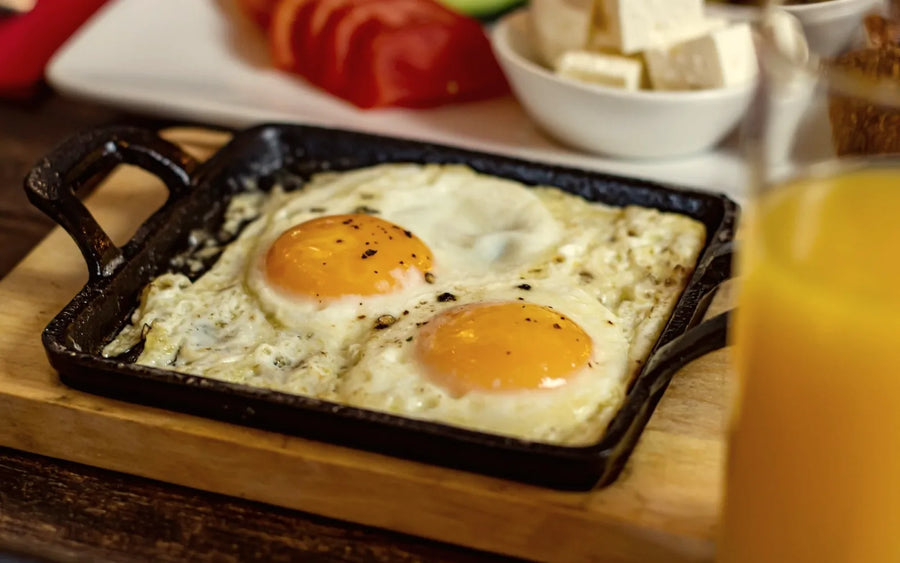
Animal protein can also "lift" plant protein. An FAO report explains that a protein with a DIAAS above 100 has the potential to complement a lower-quality protein. That's why a breakfast of bread and an egg is a better pair than it looks.

Myth
"Beans and rice have to be on the same plate, or the protein won't be absorbed." A 2013 review in the Medical Journal of Australia says strict combining isn't necessary if you eat enough, and a good variety, through the day. The body keeps a pool of essential amino acids that tops up the protein from the next meal.
Both kinds of protein have a place
In the kitchen, the "meat versus plants" war makes no sense. Animal proteins give you a lot of quality per gram. Plant proteins come with fiber and flavor that we need anyway. A good plate often has both: moussaka with salad, eggs with potatoes, beans with a little white cheese on top.
If you eat only plants, the 2013 review is reassuring: a vegetarian diet covers protein needs when you eat enough, from a variety of sources such as legumes, soy, grains, nuts and seeds.
And the most important sentence in the FAO report: quality doesn't replace quantity. A small amount of excellent protein is still a small amount of protein. We work out how much you need in our article on how much protein you need a day.

If you want to add animal protein to a plate of beans, rice or pasta without cooking meat, one option is MEALUP: egg white and milk protein concentrate with all 9 essential amino acids, which you sprinkle over the finished dish.
Frequently asked questions
Is soy a complete protein?
On DIAAS, soy flour scores 105 and soy isolate 98. That's the highest score among the plant foods in the table, and very close to the animal ones.
Is plant protein worse?
Gram for gram, it usually scores lower. A 2020 review, however, shows that the right blends of plant proteins reach high quality even without animal products. Variety and quantity close the gap.
Does cooking damage protein?
Normal cooking is fine: boiled, fried and scrambled eggs score between 135 and 137. Overcooking is where it changes: well-browned ground beef drops from 121 to 99.
Do vegetarians need to eat more protein?
According to a 2013 review in the Medical Journal of Australia, protein needs in healthy adults don't differ depending on whether the protein is animal, plant or mixed, as long as you eat soy or a variety of plant proteins. The reviews advise variety and enough food through the day. If you're pregnant, have a health condition or follow a special diet, ask your doctor.
Sources
- FAO, "Dietary protein quality evaluation in human nutrition. Report of an FAO Expert Consultation", FAO Food and Nutrition Paper 92, 2013
- Mathai JK, Liu Y, Stein HH, "Values for digestible indispensable amino acid scores (DIAAS) for some dairy and plant proteins may better describe protein quality than values calculated using the concept for protein digestibility-corrected amino acid scores (PDCAAS)", British Journal of Nutrition, 2017
- Cervantes-Pahm SK, Liu Y, Stein HH, "Digestible indispensable amino acid score and digestible amino acids in eight cereal grains", British Journal of Nutrition, 2014
- Bailey HM, Mathai JK, Berg EP, Stein HH, "Most meat products have digestible indispensable amino acid scores that are greater than 100, but processing may increase or reduce protein quality", British Journal of Nutrition, 2020
- Fanelli NS, Martins JCFR, Stein HH, "The digestible indispensable amino acid score (DIAAS) in eggs and egg-containing breakfast meals is greater than in toast breads or hash browns served without eggs", Journal of Nutritional Science, 2024
- Han F, Moughan PJ, Li J, Pang S, "Digestible Indispensable Amino Acid Scores (DIAAS) of Six Cooked Chinese Pulses", Nutrients, 2020
- Herreman L, Nommensen P, Pennings B, Laus MC, "Comprehensive overview of the quality of plant- and animal-sourced proteins based on the digestible indispensable amino acid score", Food Science & Nutrition, 2020
- Gorissen SHM et al., "Protein content and amino acid composition of commercially available plant-based protein isolates", Amino Acids, 2018
- Marsh KA, Munn EA, Baines SK, "Protein and vegetarian diets", Medical Journal of Australia, 2013