Balanced eating: the pyramid, the plate and what changed
Balanced eating means eating from the four main food groups every day, in sensible proportions: grains, vegetables and fruit, dairy, and the group of meat, fish, eggs and legumes. You probably know the food pyramid with bread at the bottom. Then came the plate, divided into halves and quarters. And in January 2026, the US turned the pyramid upside down. Here you'll find out what each of these pictures says, what the official recommendations are in Bulgaria, and how to put together a balanced plate without scales or charts.
In short
- The Bulgarian guidelines (2006) call for foods from 4 main groups every day: grains and potatoes; vegetables and fruit; milk and dairy; meat, fish, eggs, legumes and nuts.
- The "plate" model divides a meal: half a plate of vegetables and fruit, a quarter whole grains, a quarter protein.
- The new US guidelines for 2025-2030 flipped the pyramid: protein, dairy, fats, vegetables and fruit at the top, whole grains at the narrow tip.
- The US protein target there is 1.2 to 1.6 g per kilogram, above the European reference of 0.83 g (EFSA).
- What all the models share: variety, plenty of vegetables and fruit, and fewer sugary drinks.
What "balanced" means
No single food gives you everything. Bread provides energy, cheese protein and calcium, tomatoes water and vitamins, beans protein and fiber. Balanced eating is simply the idea of eating from the different groups every day, in sensible proportions.
The first Bulgarian guideline puts it in the nicest possible way: "Eat regularly and with pleasure, in a pleasant atmosphere. Take enough time for your meals." Pleasure is written into the official document. Why that matters in the long run is the subject of our article on the food you love.
The Bulgarian guidelines: 12 rules and 4 groups
Bulgaria's official healthy eating guidelines for adults date from 2006. They were developed by an expert group at the Ministry of Health with support from the World Health Organization. In 2018, the National Centre of Public Health and Analyses (NCPHA) presented them again to health professionals.
Visually, they form a pyramid with six food groups. The bigger the section, the more often you eat that group. Two tips beyond the plate come with it: water and movement every day.
| Group | How much, according to the NCPHA |
|---|---|
| Bread, grains, potatoes | 300 to 500 g a day, mostly whole grain |
| Vegetables and fruit | Over 400 g a day, varied, raw when possible |
| Milk and dairy | Every day, a cup of yogurt or milk and 50 g of white cheese (or 2 cups of milk, or 100 g of cheese) |
| Poultry and lean red meat | Up to 3 times a week, 100 g servings |
| Fish | At least 1 to 2 times a week, 150 to 200 g servings |
| Beans, lentils, soy | At least 2 times a week |
| Nuts | 30 to 50 g a day |
| Eggs | 1 a day for people without high cholesterol |
The other rules cover what to limit: added fats (vegetable oils are preferred), sugar, salt and alcohol. Plus 1.5 to 2 liters of fluids and at least 60 minutes of movement a day.
Fact
According to the NCPHA, diets in Bulgaria are low in fish and whole grains, and salt intake is 2 to 3 times above the upper limits. That's why the guidelines push for exactly these three things.

The old pyramid with bread at the bottom
The American Food Guide Pyramid comes from the US Department of Agriculture (USDA) and dates from 1992. Here's what sits on each level.
- Base: grains. Bread, cereal, rice and pasta: 6 to 11 servings a day.
- Second level: plants. Vegetables 3 to 5 servings, fruit 2 to 4.
- Third level: protein and dairy. Dairy 2 to 3 servings. Meat, fish, beans, eggs and nuts: a total of about 140 to 200 g of cooked lean meat or the equivalent.
- Top: fats and sugar. "Use sparingly", with no number of servings.
The logic was simple: eat the most from the base and the least from the top. The number of servings depended on how many calories a person needs.

The plate: easier to eat by
Servings a day are hard to count. That's where the plate came in: you look at one meal and divide it by eye. One such model is the Healthy Eating Plate from the Harvard School of Public Health.
- Half the plate: vegetables and fruit. Shopska salad (tomato, cucumber, bell pepper and white cheese), green beans, roasted bell peppers, seasonal fruit.
- A quarter: whole grains. Whole-grain bread, bulgur, brown rice, oats.
- A quarter: protein. Fish, chicken, eggs, beans, lentils, nuts.
- On the side: water and olive oil. Water, coffee or tea to drink, and skip the sugary drinks. Vegetable oil for cooking.
The Harvard plate limits dairy to 1 or 2 servings a day. This is where the Bulgarian and US guidelines part ways with it: both treat milk and cheese as a separate everyday group.
The new US pyramid (2025-2030)
In January 2026, the US Departments of Health and Human Services and of Agriculture published the "Dietary Guidelines for Americans, 2025-2030". Their main message is "Eat real food".
The new picture is an upside-down pyramid. The wide top is split in two: "Protein, dairy and healthy fats" and "Vegetables and fruits". At the very bottom, on the narrow tip, sit "Whole grains".
| Group | 1992 pyramid | 2025-2030 guidelines |
|---|---|---|
| Grains | 6 to 11 servings, the base | 2 to 4 servings of whole grains, at the bottom |
| Vegetables | 3 to 5 servings | 3 servings |
| Fruit | 2 to 4 servings | 2 servings |
| Dairy | 2 to 3 servings | 3 servings, including full-fat with no added sugar |
| Protein | about 140 to 200 g of meat or the equivalent | 1.2 to 1.6 g of protein per kg of body weight a day, at every meal |
| Fats and sugar | Sparingly, at the top | Fats from whole foods; up to 10 g of added sugar per meal |
The servings in the guidelines are based on 2 000 kcal a day and are adjusted to individual needs. For the first time, the US guidelines explicitly say to avoid highly processed foods: chips, cookies, candy, sugary sodas. For fats, olive oil comes first, with butter and beef tallow mentioned as other options.

Which guidelines apply in Bulgaria
The US guidelines were written for Americans and the way they eat. In Bulgaria, the official framework is still the NCPHA's, and for protein in Europe the reference comes from EFSA: 0.83 g per kilogram a day for healthy adults. To work it out for your weight and see when your needs go up, read our guide to how much protein you need a day.
The models argue over the details: how much grain, which fats, how much milk. On the big picture, though, they agree. They all want foods from different groups, plenty of vegetables and fruit, protein from a variety of sources and fewer sugary drinks. If you have a health condition or are pregnant, ask your doctor which model is right for you.
How to do it without a scale
The good news: Bulgarian cooking is already full of balanced meals. One look at your plate is all it takes.
- Bob chorba (bean soup), shopska salad and a slice of whole-grain bread. Protein from the beans, vegetables from the salad, grains from the bread, a little white cheese on top.
- Moussaka with yogurt and salad. Ground meat and eggs for protein, potatoes as the grain quarter, salad for half the plate.
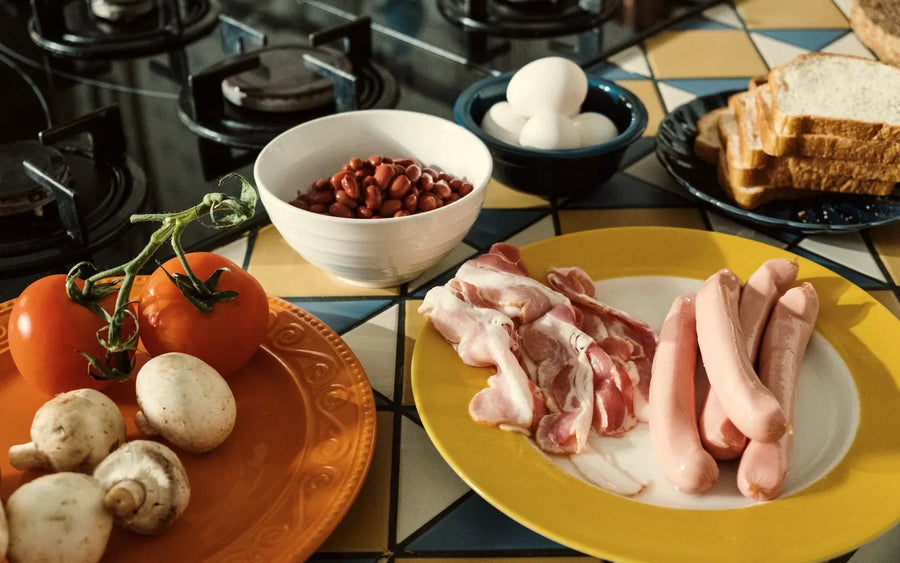
- Breakfast: 2 eggs, tomatoes, a piece of white cheese and a slice of bread. Four groups on one board and about 20 g of protein.
- Fish once a week. Baked mackerel or trout with potatoes and a green salad also ticks off the fish recommendation.
Tip
Look at your plate before the first bite. If protein takes up less than a quarter, add an egg, some white cheese, yogurt, a handful of nuts or a spoonful of beans from yesterday's pot.
And when the meal is your favorite pasta or a vegetable dish and the protein falls short, you can add it to the same plate: 1 serving (30 g) of MEALUP sprinkled over the finished dish gives at least 20 g of protein. For how much protein everyday foods contain, see our article on protein in foods.
Which is the better model, the pyramid or the plate?
They answer different questions. The pyramid shows the proportions for the whole day, the plate for a single meal. The plate is easier for everyday use because it doesn't involve counting.
Do the new US guidelines apply to me?
They were written for the US population. In Bulgaria, the official guidelines come from the NCPHA, and for protein in the EU the reference is EFSA's. If you have a health condition, are pregnant or are breastfeeding, ask your doctor.
How much protein do the new US guidelines recommend?
From 1.2 to 1.6 g per kilogram of body weight a day, spread across every meal and matched to the calories a person needs. At 65 kg, that's 78 to 104 g.
Do I have to count servings?
You can skip the counting. Dividing your plate by eye (half vegetables, a quarter protein, a quarter grains) gets you close, no scale needed.
Are potatoes a vegetable?
In the Bulgarian guidelines, potatoes are in the same group as bread and grains.
Sources
- NCPHA, Food and Nutrition Department, "Healthy eating recommendations for the adult population and pregnant and breastfeeding women in Bulgaria" (in Bulgarian), 2018
- FAO, "Food-based dietary guidelines: Bulgaria"
- European Commission, Knowledge for Policy, "Food-based dietary guidelines in Europe"
- USDA Agricultural Research Service, Food Surveys Research Group, "Pyramid Servings Data: Results from USDA's 1995 and 1996 CSFII" (based on the Food Guide Pyramid, USDA 1992), 1999
- Harvard T.H. Chan School of Public Health, "Healthy Eating Plate"
- U.S. Department of Health and Human Services, U.S. Department of Agriculture, "Dietary Guidelines for Americans, 2025-2030", January 2026
- HHS and USDA, "Eat Real Food", realfood.gov
- EFSA, "EFSA sets population reference intakes for protein", 2012