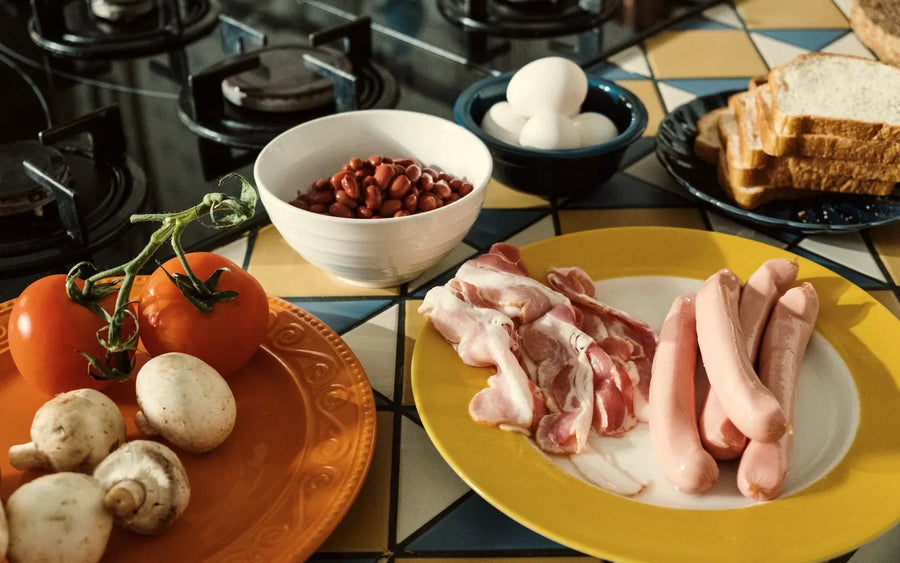
How much protein is in food? Eggs, cheese, beans, meat and nuts
Per 100 g, eggs have 12.6 g of protein, Bulgarian white cheese 15 to 17 g, kashkaval (Bulgarian yellow cheese) about 24 g, cooked beans about 10 g and roasted chicken breast 31 g. Kashkaval beats white cheese, and beans soak up water in the pot, which is why their number per 100 g drops. Here are the numbers for the foods we actually eat in Bulgaria, per 100 g and per normal serving, each with a source.
In short
- Per 100 g, the everyday foods with the most protein are roasted chicken breast (31 g) and kashkaval (about 24 g). Dry beans have 23 g, cooked beans about 10 g.
- Raw and cooked food give different numbers because of water: meat loses it, beans soak it up.
- Yogurt has about 3.5 g per 100 g, but a whole 400 g tub gives you 13 to 15 g.
- The numbers come from the USDA FoodData Central database and from the labels of products sold in Bulgaria.
Where the numbers come from
Our main source is FoodData Central from the US Department of Agriculture (USDA). We use its SR Legacy section: data on 7 793 foods, last released in April 2018. All values are grams of protein per 100 g of the edible part.
The US database has no "white brined cheese" and no "kashkaval". So for these two, we also checked the labels of 8 products each, all sold in Bulgaria and listed in the open database Open Food Facts. Where the two sources differ, we give both numbers.
One caveat: these are averages. Your white cheese or your kashkaval may be a gram or two higher or lower. For the exact number for a specific product, check the label.
Eggs, meat and fish
No surprises here, but there is one trap: raw and cooked meat differ by 8 to 9 g per 100 g.
| Food | Raw or cooked | Protein per 100 g |
|---|---|---|
| Egg, whole | raw | 12.6 g |
| Egg, whole | hard-boiled | 12.6 g |
| Chicken breast, skinless | raw | 22.5 g |
| Chicken breast, skinless | roasted | 31.0 g |
| Ground beef (85% lean, 15% fat) | raw | 18.6 g |
| Ground beef (85% lean, 15% fat) | pan-browned | 27.7 g |
| Pork tenderloin | raw | 21.0 g |
| Tuna, canned in water, drained | ready to eat | 19.4 g |
| Mackerel | raw | 18.6 g |
Eggs are interesting: boiled or raw, the number stays at 12.6 g. The white and the yolk differ, though. Per 100 g, the yolk has more protein (15.9 g versus 10.9 g), but the white weighs almost twice as much, so in a single egg it carries more.
White cheese, kashkaval and yogurt
The Bulgarian fridge is full of protein. It's just spread unevenly. In the dairy aisle, kashkaval is the champion per 100 g. Yogurt is the most modest per 100 g, but we eat it by the tub.
| Food | USDA, per 100 g | Labels in Bulgaria, per 100 g |
|---|---|---|
| Cow's milk kashkaval | no exact match (provolone 25.6 g) | 20 to 26.5 g, most often 23.5 to 26 g |
| White brined cheese | 14.2 g (feta) | 12 to 17 g, most often 15 to 17 g |
| Cottage cheese (Bulgarian izvara) | 11.1 to 12.4 g (US cottage cheese) | varies by product |
| Strained yogurt | 9.0 g (Greek, whole milk) | not compared |
| Yogurt | 3.5 g (whole milk) | 3.2 to 3.8 g |
| Milk, whole | 3.2 g | not compared |
Why does kashkaval lead? It's drier. In the USDA data, provolone, a close relative of kashkaval, is 41% water and feta 55%. The less water, the more protein per 100 g. Feta is only a rough guide for white cheese: every dairy has its own recipe, which is why labels in Bulgaria run a little above it.

Beans, lentils, chickpeas and nuts
With legumes, the numbers look confusing until you see which are dry and which are cooked. Dry beans from the bag are concentrated. In the pot they soak up water, and the protein per 100 g is cut in half.
| Food | Dry or raw | Cooked |
|---|---|---|
| White beans | 23.4 g | 9.7 g |
| Chickpeas | 20.5 g | 8.9 g |
| Lentils | 24.6 g | 9.0 g |
Three more benchmarks: dry soybeans have 36.5 g per 100 g, oats 16.9 g, and tofu anywhere from 8.1 g (regular) to 17.3 g (firm), depending on how much it's pressed.
Nuts are dense in protein, but we eat them by the handful.
| Nut | Protein per 100 g |
|---|---|
| Peanuts, raw | 25.8 g |
| Almonds | 21.2 g |
| Walnuts | 15.2 g |
| Hazelnuts | 15.0 g |
With plant foods, protein quality matters too. We explain how beans and rice complement each other in our article on animal and plant proteins.
Raw or cooked: why the numbers jump
Cooking mainly changes the water in food. Dry white beans are 11% water, cooked ones 63%. Meat in the pan loses water and shrinks, which is why 100 g of roasted chicken has 31 g of protein and 100 g of raw chicken has 22.5 g. Beans and lentils do the opposite: they soak up water, swell, and the protein per 100 g goes down.
So when you compare foods, compare them in the same state. Raw with raw, cooked with cooked. Otherwise the ground beef in the pan looks like a miracle and the beans in the soup like a letdown.

Myth
"Boiling beans makes the protein disappear." The number per 100 g really does drop from 23.4 to 9.7 g, but the reason is the water the beans soak up. A bowl of cooked beans still gives you a good amount of protein: see the servings below.
What a normal serving gives you
Nobody eats "100 g of yogurt". Here are the same foods in the servings we actually put on our plates. The math uses USDA data and Bulgarian labels.
| Serving | Protein |
|---|---|
| 2 large eggs (about 100 g without the shells) | 12.6 g |
| 120 g roasted chicken breast | 37 g |
| 100 g drained tuna | 19 g |
| 100 g white cheese | 14 to 17 g |
| 50 g kashkaval | 12 to 13 g |
| Tub of yogurt, 400 g | 13 to 15 g |
| 200 g strained yogurt | 18 g |
| 150 g cottage cheese | 17 g |
| 200 g cooked beans | 19.5 g |
| 200 g cooked lentils | 18 g |
| 30 g almonds (about 25 nuts) | 6 g |
| 1 slice whole-grain bread (32 g) | 4 g |

How many of these servings you need a day depends on your weight and age. The math is in our article on how much protein you need a day. And for why it helps to spread protein across breakfast, lunch and dinner, see our guide to spreading protein through the day.
How to read the label
In the EU, most packaged foods must carry a nutrition table, and protein is a mandatory line in it. The numbers are per 100 g or 100 ml, so two products are easy to compare even in different pack sizes.
According to the European Commission, two phrases on the pack follow exact rules:
- "Source of protein". At least 12% of the energy (calories) in the food comes from protein.
- "High protein". At least 20% of the energy comes from protein.
Tip
With kashkaval and white cheese, compare two or three labels on the shelf. For kashkaval, the difference between brands in Bulgaria goes up to 6.5 g of protein per 100 g.
What to take away from all this
Most of the protein you need is already in your fridge. A few easy moves:
- Add an egg or a piece of white cheese to your morning slice of bread. Two eggs are 12.6 g.
- 200 g of cooked beans with 30 g of white cheese on top add up to about 24 g in one bowl.
- Yogurt with a handful of walnuts gives you protein from two sources at once.
- Pasta, rice and potatoes are low in protein. Pair them with an egg, cheese, beans or meat.
For the days when you want more protein in the same pasta or omelet without changing the recipe, we made MEALUP. It's a savory protein powder made from egg white and milk protein: 1 serving (30 g) gives at least 20 g of protein, and you sprinkle it over the finished dish.
How much protein is in one egg?
One large egg (about 50 g without the shell) has about 6.3 g of protein, a medium one (44 g) about 5.5 g. Of that, about 3.6 g is in the white and about 2.7 g in the yolk.
Which has more protein, white cheese or kashkaval (yellow cheese)?
Kashkaval. It has about 24 g per 100 g, white cheese 15 to 17 g, going by labels in Bulgaria. Kashkaval contains less water, so its protein is more concentrated.
Do beans lose their protein when you boil them?
Hardly at all. The number per 100 g drops from 23.4 to 9.7 g because the beans soak up water. 200 g of cooked beans still give you about 19.5 g of protein.
Why do labels for the same kind of product show different numbers?
Every producer has its own recipe, moisture and fat content. For cow's milk kashkaval, labels in Bulgaria range from 20 to 26.5 g per 100 g.
Is the plant protein in beans the same as the protein in meat?
The grams count the same, but the quality differs. We go into detail in our article on animal and plant proteins.
Sources
- U.S. Department of Agriculture, Agricultural Research Service, "FoodData Central: SR Legacy", April 2018 release
- USDA FoodData Central, "Egg, whole, raw, fresh" (171287), also 173424, 172183, 172184
- USDA FoodData Central, "Chicken breast, skinless, boneless, meat only, raw" (171077), also 171477, 171796, 174034, 168249, 173709, 175119
- USDA FoodData Central, "Cheese, feta" (173420), also 170850, 172179, 173417, 171284, 171304, 171265
- USDA FoodData Central, "Beans, white, mature seeds, cooked, boiled" (175203), also 175202, 172420, 172421, 173756, 173757, 174270, 172475, 172476, 169705
- USDA FoodData Central, "Nuts, almonds" (170567), also 170187, 170581, 172430, 172688
- Open Food Facts, labels of kashkaval, white cheese and yogurt sold in Bulgaria, accessed 21.10.2026
- European Commission, "Nutrition claims" (annex to Regulation (EC) No 1924/2006)
- European Commission, "Nutrition labelling" (Regulation (EU) No 1169/2011)